
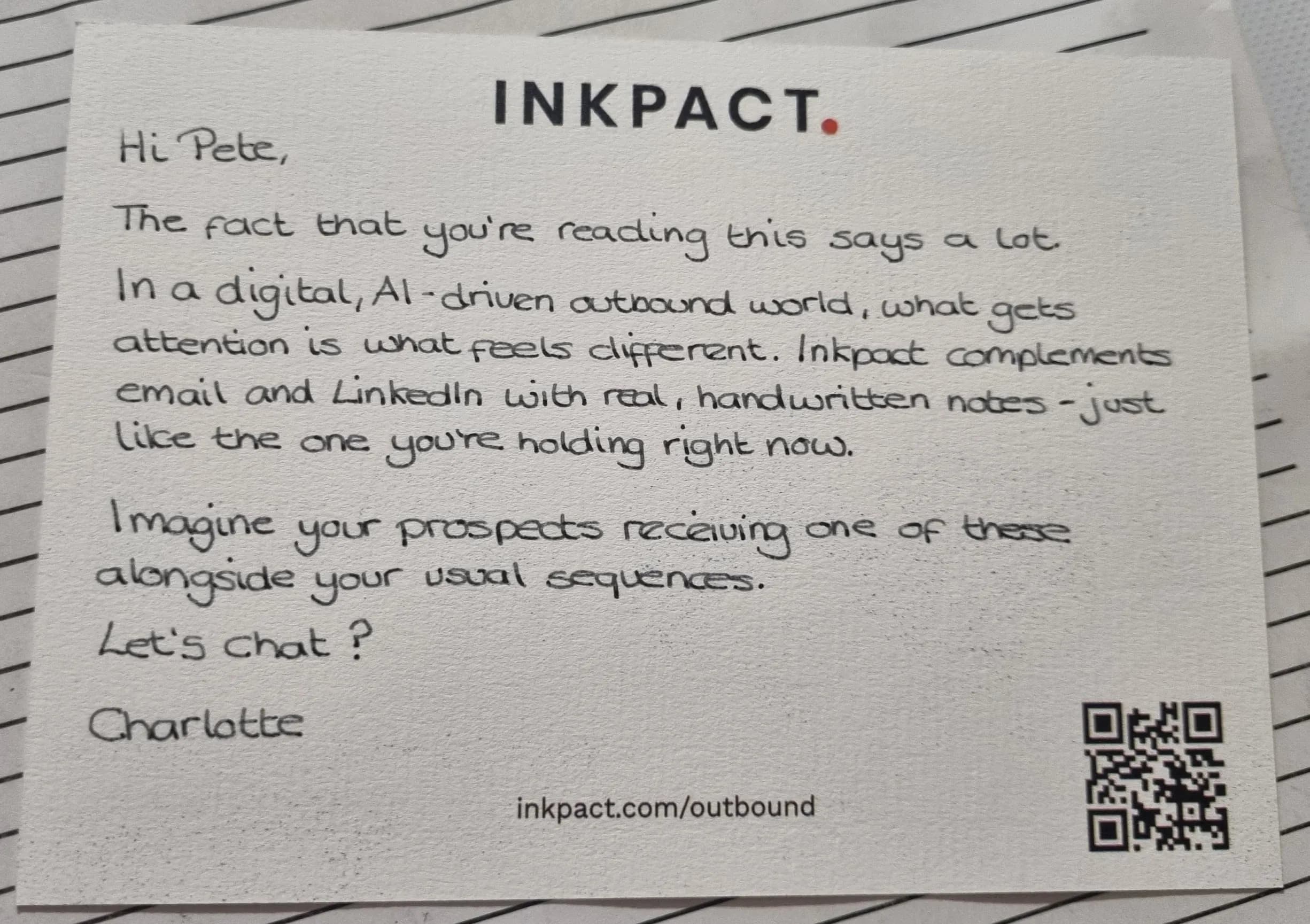
Handwritten Direct Mail: The B2B Channel That Converts
Your prospects are drowning. Their inbox holds 147 unread emails. Their LinkedIn is full of "quick question" messages from people they have never met. Every outbound channel that was once effective has been optimised into irrelevance. And yet, a small number of B2B teams are consistently booking more meetings and warming cold accounts using a channel most growth leaders dismissed a decade ago: handwritten direct mail.
Why the Psychology Works in Your Favour
The effectiveness of handwritten direct mail is not a matter of opinion. It is grounded in behavioural science.
When a prospect receives a handwritten note, their brain registers something fundamentally different from a templated email. They recognise that someone took time. That the message required physical effort. That it was not mass produced. This triggers what researchers call the effort heuristic: we assign greater value to things that appear to have required more effort to create. A handwritten note signals care and intention in a way that no automated email sequence ever will.
It also activates reciprocity. When someone invests effort in reaching out to us, we feel a measurable pull to respond. Not because we owe them anything, but because that is how human social dynamics work.
The attention gap is equally significant. Your average B2B buyer receives hundreds of emails and dozens of LinkedIn messages every week. Now consider what arrives in their physical mail: almost nothing of personal relevance. That asymmetry is the opportunity. Physical mail occupies an entirely different attentional space. It is tangible, it cannot be swiped away, and it sits on a desk demanding a moment of engagement. Research from the Direct Marketing Association shows physical mail achieves open rates above 90%, compared to around 20% for B2B email. Handwritten mail pushes those numbers higher still, because a handwritten envelope is almost impossible to ignore.
The B2B Use Cases That Drive the Most Pipeline
Handwritten direct mail fits into multiple points across the B2B sales and marketing funnel.
Outbound prospecting. For SDR and BDR teams, handwritten notes are a powerful way to break through to prospects who are unreachable through email and LinkedIn. The proven sequence: send the handwritten note first, then follow up three to five days later with a personalised email referencing the note. When the email arrives, it is no longer cold. Teams using this approach report 3x to 5x improvements in meeting booking rates compared to email-only cadences. If you are running outbound prospecting at scale, handwritten notes should be your highest-leverage channel.
Account based marketing. ABM campaigns depend on creating meaningful engagement with a defined list of target accounts. A handwritten note sent to a specific decision maker at a target account can open doors that months of digital outreach failed to unlock, particularly when the note references a recent company announcement, a specific challenge relevant to their role, or a shared connection. RingCentral deployed Inkpact across their ABM programme, sending 5,000 personalised packages per year to target accounts as part of their client acquisition strategy.
Reactivation of lost deals. Every B2B company has a graveyard of gone-cold contacts in their CRM. A handwritten note sent to 500 lapsed contacts represents a fundamentally different stimulus than another automated email. The note reframes the relationship and re-establishes human connection with prospects who had become desensitised to digital outreach. For more on the psychology behind reactivation, see why direct mail outperforms digital marketing.
Post-event follow up. Most teams send a templated email after meeting a prospect at a conference and wonder why conversion rates remain low. A handwritten note that arrives five to seven days after the event cuts through the noise of a hundred other follow ups, reinforces the personal connection made in person, and signals a level of effort the prospect will remember.
Handwritten vs Printed Direct Mail: Where the Gap Opens
Not all direct mail is created equal. The distinction between handwritten and printed mail directly affects performance.
| Factor | Handwritten | Printed |
|---|---|---|
| Open rate | Near 100% | 60–80% |
| Response rate | 5–20%+ | 1–5% |
| Perceived effort | High (recipient recognises human involvement) | Low (feels mass produced) |
| Best for | ABM, high-value prospecting, reactivation | Volume plays, brand awareness |
Printed direct mail still has a place in high-volume brand campaigns. But when the goal is engagement, response, and relationship building, handwritten wins. The question is not "which is cheaper per send" but "which delivers more pipeline per pound spent." On that metric, handwritten direct mail consistently outperforms.
How Automated Handwritten Notes Actually Work
This is where most people get sceptical. How can something be both automated and genuinely handwritten?
The key distinction is between automating the workflow and automating the writing. The workflow (triggering, personalising, scheduling, tracking) is automated through CRM integrations like Klaviyo, HubSpot, or a direct API connection. The writing is always done by a real person.
At Inkpact, every note is written by a real human being from our global network of 1,500+ scribes. Not a robot. Not a pen plotter. Not a font that mimics handwriting. An actual person picks up a pen and writes your message on a notecard.
Your CRM triggers the campaign based on events: a deal going cold, a prospect visiting your pricing page, or a contract renewal approaching. Inkpact handles the writing, packaging, and posting. Turnaround is typically three working days from trigger to posting. Performance data feeds back into your CRM so you can measure impact alongside every other channel.
The ROI Case: Campaign Maths for B2B Teams
Let us put numbers to it.
Email-only cadence: Send 1,000 emails. Achieve a 2% response rate. That gives you 20 responses. Convert 25% to meetings. That is 5 meetings from 1,000 touches.
Handwritten direct mail cadence: Send 200 notes at £5.75 each (£1,150 total). Achieve a 10% response rate. That gives you 20 responses. Convert 40% to meetings (the lead is warmer). That is 8 meetings from 200 touches at £1,150 total, working out to roughly £144 per meeting booked.
For ABM campaigns targeting enterprise accounts where a single closed deal is worth £50,000 to £500,000, the cost per note becomes irrelevant. A campaign of 100 notes at £4,000 total that generates a single enterprise deal delivers ROI measured in multiples, not percentages.
Handwritten direct mail consistently delivers the strongest returns in three scenarios: high-value deals where the note cost is negligible relative to contract value; reactivation campaigns where you are working an existing warm asset rather than acquiring cold leads; and ABM programmes where precision targeting justifies a premium cost per send.
Five Steps to Running Your First Campaign
Step 1: Define a tight list. Quality over quantity: 200 well-targeted notes outperform 2,000 poorly targeted ones. For prospecting, focus on accounts where the deal size justifies the investment. For reactivation, pull contacts who engaged at some point but went cold.
Step 2: Craft a short, specific, human message. Keep it under 100 words. Reference something specific: the prospect's company, a recent announcement, or their role. Write like a person, not a brand. Include a soft call to action that creates curiosity rather than closing a deal on the page.
Step 3: Integrate it into your existing cadence. Handwritten direct mail works best as part of a multi-channel strategy, not in isolation. Send the note first. Follow up three to five days later with a personalised email that references it. Add LinkedIn. The note opens the door; your follow-up walks through it.
Step 4: Time the send correctly. Tuesday through Thursday delivery performs best for prospecting. For reactivation, send within two weeks of a deal going cold. For event follow-ups, aim for delivery five to seven days after the event, fast enough to be relevant but slow enough to avoid the initial inbox flood.
Step 5: Measure against the right metrics. Response rate, meetings booked, pipeline generated. Use CRM integration for attribution. Run A/B tests on messaging and timing. The data will show you where the channel creates most value in your specific funnel.
Common Mistakes That Kill Results
Generic messaging. "I would love to tell you about our product" is not a handwritten note. It is a cold email written on expensive paper. If your message could be sent to anyone at any company without changing a word, you are wasting the format.
Poor targeting. Sending a handwritten note to the wrong person signals you did not do your research, which is the opposite of what the format is supposed to communicate. Invest in list quality before you invest in sends.
No follow-up plan. A handwritten note generates awareness and goodwill. Without a follow-up sequence planned, much of that impact dissipates. The note is the opening move, not the whole game.
Using it as a standalone channel. Handwritten direct mail is most powerful as the channel that makes all your other outbound channels work better, not a replacement for them. See how direct mail fits into modern attention-economy marketing for a wider strategic view.
TL;DR: Key Takeaways
- Handwritten notes achieve 5–20% response rates versus 1–3% for cold email, a genuine, measurable performance gap.
- The format works because of effort perception and reciprocity. Behavioural science principles email cannot replicate.
- Strongest ROI in three scenarios: high-value ABM, reactivation campaigns, and post-event follow-up.
- Automation handles the logistics; real people do the writing. CRM integrations trigger sends; Inkpact's scribes write every note by hand.
- Cost per meeting booked, not cost per send, is the right metric. At around £144 per meeting in a typical cadence, the economics are compelling.
- Start small and measure. 100–200 well-targeted notes, a clear message, and a follow-up sequence is all you need to test whether the channel works in your market.
What is handwritten direct mail?
Handwritten direct mail is physical mail containing a message written by hand (typically on a notecard or branded stationery) sent to a specific recipient as part of a targeted sales or marketing campaign. Unlike printed mail, it is written by real people and triggers a fundamentally different psychological response in the recipient.
How does handwritten direct mail compare to email in B2B outreach?
Handwritten direct mail consistently outperforms email in B2B contexts. Cold email response rates average 1–3%, while handwritten direct mail campaigns regularly achieve 5–20% response rates. Physical mail achieves near-100% open rates compared to around 20% for B2B email, and the format activates reciprocity and the effort heuristic in ways email never will.
What response rates can B2B teams expect from handwritten direct mail?
Most handwritten direct mail campaigns achieve response rates between 5% and 15%. High-value ABM campaigns with strong personalisation frequently exceed 20%. Inkpact campaigns targeting customer reactivation and ABM have delivered response rates up to 20x higher than traditional digital channels.
How much does a handwritten direct mail campaign cost?
A typical handwritten note with branded stationery, personalised wax seal, and first class postage runs between £5 and £40 per contact depending on the package and volume. For enterprise deals where a single contract is worth £50,000 or more, the cost per send is negligible relative to pipeline impact. The right metric is cost per meeting booked, not cost per send.
Can handwritten notes be automated and personalised at scale?
Yes. Modern handwritten direct mail platforms like Inkpact combine CRM integration with real human scribes to automate the workflow while keeping the handwriting genuine. Your CRM triggers sends based on events like a deal going cold or a contract renewal approaching. The automation handles logistics and personalisation data; every note is still written by hand by a real person.